
The Ordinary Stories Your Family Will Treasure Most
Grandparents often think their stories are too ordinary to tell. Their grandchildren, and the research, say otherwise.
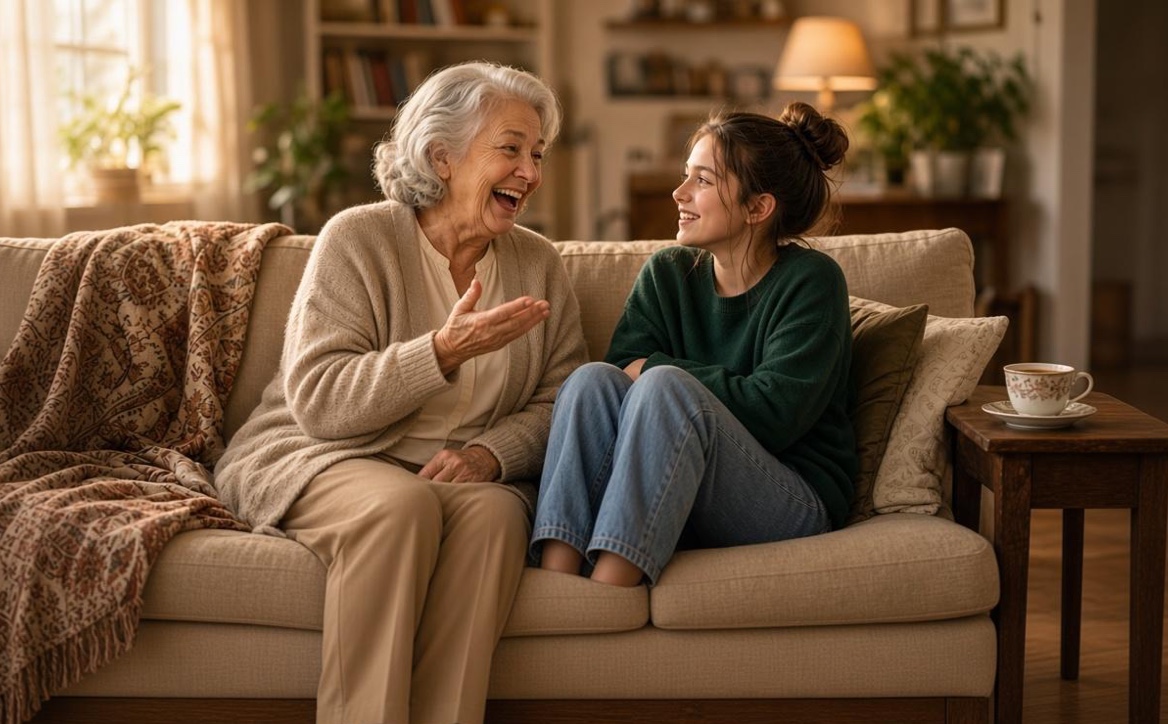
Ask a grandparent about their life and you’ll often hear, “Oh, there’s not much to tell.”
Then a grandchild asks what school was like, or what they did on a Saturday, and half an hour later nobody has moved. The tea has gone cold. Someone is laughing. And a story nobody had heard before is out in the open.
It turns out there’s a good reason for that.
The Stories That Live in the Everyday
When families talk about the stories they treasure, it’s rarely the headline moments. It’s the texture of a life.
How you met. Where you grew up. Your first job. What Christmas was like when you were small. The walk to school. Sunday dinners. The neighbour everyone talked about. What you did on a rainy day.
These are the details nobody writes down, because at the time they seem too normal to mention. They’re also the ones that make a grandchild say, “Really? Tell me more.”
Your Grandchildren Want to Hear It
Most of us underestimate how much other people want to hear about our lives.
In 12 experiments with more than 1,800 people, researchers from Northwestern University, the University of Texas and the University of Chicago found that people consistently underestimated how interested others would be in learning about them. The conversations went better than expected, and people enjoyed them more than they thought they would.
Those were strangers. Imagine how much more your grandchildren want to know.
Why Ordinary Becomes Extraordinary
We also underestimate how much our everyday moments will mean later. In 2014, researchers at Harvard Business School asked 135 university students to make a time capsule.
Nothing special went in. A recent conversation. Three songs they were listening to. A social event they’d been to. A few lines from an assignment.
The students predicted how interesting they’d find it all when they opened it again. Three months later, they did. They were far more curious and interested than they had expected.
The lead researcher, Ting Zhang, summed it up: “What is ordinary now actually becomes more extraordinary in the future, and more extraordinary than we might expect.”
The small days matter as much as the big ones
The same team found something even more surprising.
People were fairly good at predicting how much they’d enjoy looking back on a special day, like Valentine’s Day. But they underestimated how much they’d enjoy looking back on an ordinary day with the person they loved.
We think the big moments are the ones worth keeping. Time tells us the small ones matter just as much.
If three months can make an ordinary conversation feel special, imagine what years can do.
Memories Fade. Recordings Don’t.
There’s one more reason the everyday stories are worth keeping now. Our memories are wonderful storytellers, but they aren’t built to hold everything.
When researchers recorded three-year-olds talking about recent events, like a trip to the zoo or a birthday party, and asked them again years later, children aged five to seven could still recall most of those events. By eight and nine, they remembered only about a third.
So the little ones listening to Grandma’s stories today may not remember many of them later. Not because the stories didn’t matter, but because young memories are still growing.
Adult memories shift too. The morning after the Challenger space shuttle disaster in 1986, university students wrote down how they had heard the news. Two and a half years later, many told a noticeably different story, and they were still confident they had it right.
That’s the beauty of recording a story. It stays exactly as it was told, in the voice of the person who told it.
If It’s Your Story
A memoir doesn’t need a big plot. It needs your voice.
You don’t have to choose your most impressive moments. Start with an ordinary one. What a normal Tuesday looked like. What was on the table at dinner. Who you sat next to at school. The research suggests those are the stories you, and the people you love, will enjoy most.
If It’s Your Parent or Grandparent’s Story
Next time you’re with them, skip the big questions. Ask about an ordinary day instead. It’s easier to answer, it’s often funnier, and it opens the door to everything else.
12 Everyday Questions
- What did a normal school morning look like?
- What did your family eat for dinner most nights?
- Who lived next door, and what were they like?
- What did you do after school?
- What was in your pockets as a kid?
- What did your bedroom look like?
- What did a normal Saturday look like when you were ten?
- How did you get to your first job, and what was the trip like?
- What did you and your friends talk about for hours?
- What chores did you have, and which one did you dodge?
- What did you do on a rainy day?
- What did your street sound like in the morning?
Pick one, press record, and see where it goes.
When you’re ready, you can record your story, or a parent’s story, at FromBeyond.co.
Want more questions like these? Email hello@frombeyond.co with “Life story questions” in the subject line, and we’ll send you our free question pack, The Questions We Never Asked. We’ll only use your email address to send it.
What’s an ordinary moment from your childhood you can still see clearly?
Keep reading
Alice Footer, Co-Founder of FromBeyond.co
FromBeyond.co helps families ask the questions that matter, and keep the answers forever, in the voices they love.
Sources
- Bauer and Larkina, The onset of childhood amnesia in childhood, Memory, 2013, reported by ScienceDaily
- Neisser and Harsch, Phantom flashbulbs: false recollections of hearing the news about Challenger, 1992, summarised by The MIT Press Reader
- Zhang and colleagues, A “present” for the future: the unexpected value of rediscovery, Psychological Science, 2014, reported by ScienceDaily
- Kardas, Kumar and Epley, Overly shallow?: Miscalibrated expectations create a barrier to deeper conversation, Journal of Personality and Social Psychology, 2021, reported by the American Psychological Association
Preserve the stories that matter
Create a video keepsake for someone you love, delivered at exactly the right moment.
Get StartedShare this article