
When Does Your Story Start to Matter to You?
There's a moment in most lives when your own story starts to feel important. Psychologists have a surprisingly clear picture of when it happens.
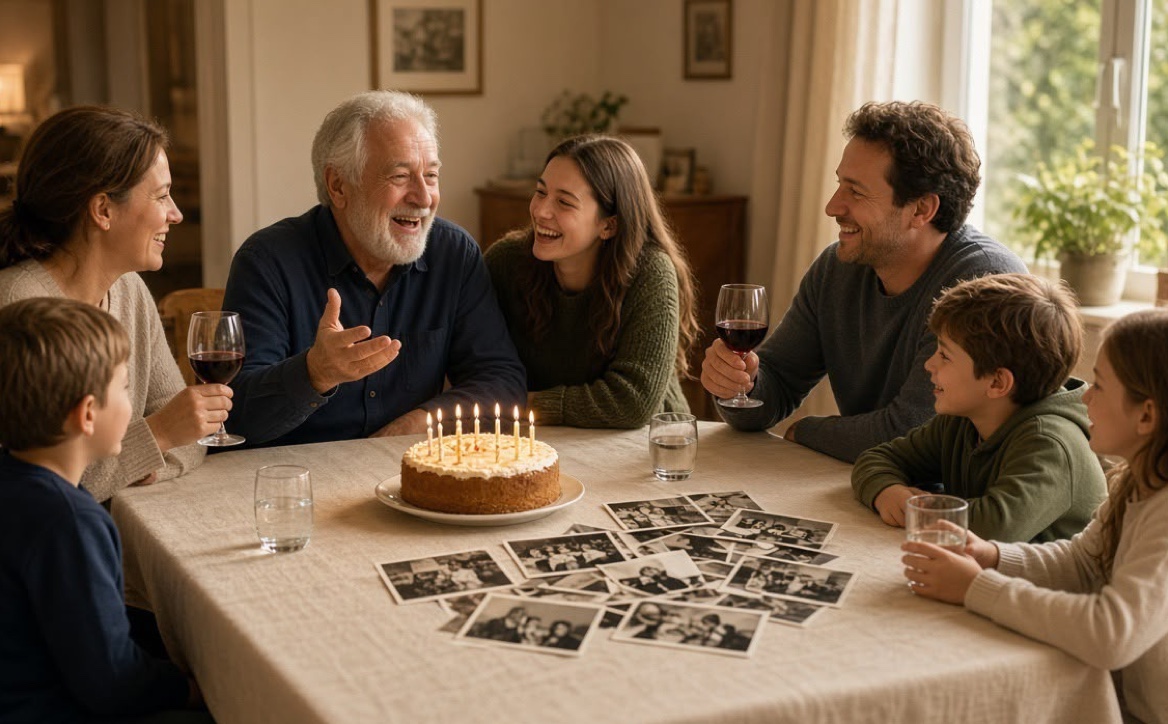
The candles are lit, everyone’s singing, and halfway through the cake someone asks Grandad what his twenty-first was like. Twenty minutes later, the whole table is still listening.
Most of us have seen that moment. A big birthday comes around, a grandchild arrives, someone brings out the old photos, and suddenly you realise how much there is to tell.
I’ve asked my own grandparents whether their stories matter to them. They told me they do.
That made me wonder whether there’s a point in life when this happens for most of us. It turns out the research has a lot to say.
Is There an Age When It Clicks?
There isn’t one magic age. But there are four very clear turning points: midlife, later life, the year before a big birthday, and any time life starts to feel precious.
In midlife, we start thinking about who comes next
The psychologist Erik Erikson described middle adulthood, from around our forties to our mid-sixties, as the stage of generativity: wanting to guide and give something to the next generation.
It’s often the age when people start asking their own parents about the past, and start wondering what they’ll pass on themselves.
In later life, memories come back clearer
In the 1960s, the psychiatrist Robert Butler described the life review: a natural process in later life, where people look back over their lives and make sense of them. He noticed that early memories often return with unusual clarity.
Erikson saw this stage, from around 65 onwards, as a time for looking back and seeing what a life has added up to.
That’s why so many older people start telling stories you’ve never heard before. It isn’t rambling. It’s the mind doing exactly what it’s meant to do.
Big birthdays make us stop and think
Researchers Adam Alter and Hal Hershfield studied more than 42,000 adults across 100 countries. They found that people whose age ends in a nine, like 49, 59 or 69, were more likely to say they spend time thinking about the meaning and purpose of their lives.
The year before a new decade seems to make us take stock.
When time feels precious, we focus on what matters most
Stanford psychologist Laura Carstensen’s research suggests that as we come to see our time as precious, our goals shift away from exploring and collecting new things, and towards what is emotionally meaningful: the people we love, and the moments that matter.
It isn’t only about age. A new grandchild, retirement or a big change in life can bring that feeling closer at any age.
The Stories We Love to Tell
Researchers have found something else that explains a lot about family dinners.
When older people recall their lives, they remember far more from roughly their teens and twenties than from any other time. Psychologists call it the reminiscence bump.
First jobs. First loves. The mischief. The adventures. That’s where the best stories live, and it’s usually where people want to start.
Why Telling It Is Worth It
When that moment comes, acting on it is good for everyone.
A review of 15 studies found that older people who share their life story tend to feel happier and more satisfied with their lives.
And it matters for the people listening. A Boston College study that followed grandparents and their adult grandchildren for nearly 20 years found that emotionally close relationships were linked to fewer symptoms of depression in both generations.
The Gap Between Wanting and Doing
So if our stories start to matter, why don’t more of us tell them?
In a 2022 YouGov survey of more than 6,000 adults in the United States, only 33% had ever recorded or documented a conversation with someone they love.
That isn’t because people don’t care. It’s because modern life is busy, families are spread out, and “one day” always feels like plenty of time. The stories are there. The moment to ask just keeps slipping past.
The good news is that it doesn’t take a project or a free weekend. It takes one question, asked at the right moment, and somewhere to keep the answer. That’s the gap we built FromBeyond.co to close.
What This Means for You
If you’re in your forties or fifties, you’re in the generativity years. You’re probably thinking about your kids, and about your parents. It’s a natural time to ask your mum or dad about their life, and to start thinking about your own story too. At the next family birthday, sit beside them, choose one question, and record their answer together.
If you’re in your sixties, seventies or eighties, you’re in the season when memories come back clearest. You don’t need to write a book. You can simply talk, and record it, one story at a time, in your own voice. No writing needed.
20 Questions That Bring Out the Best Stories
These questions are built around the turning points above. Pick one, ask it at the next family lunch or answer it yourself, and press record.
The years we remember most
The reminiscence bump means the teens and twenties are the easiest place to start.
- What song takes you straight back to being 17?
- Where did you go when you wanted to have fun at 20?
- Who was your best mate at 18, and what did you get up to?
- What did your first home of your own look like?
The turning points
Looking back over your whole life, not just single moments, is linked to the biggest boost in wellbeing.
- What year changed everything for you?
- What’s a door that opened when you least expected it?
- When did you take a leap you’re glad you took?
- What seemed like a disaster at the time but turned out well?
The milestones
Big birthdays make us think about meaning and purpose.
- What birthday made you stop and think about your life?
- What did you imagine your life would be like at the age you are now?
- When did you first feel like a real grown-up?
- What do you understand now that you didn’t understand at 25?
The people who mattered
When time feels precious, we focus on the people who mean the most.
- Who taught you the most about life?
- Who could always make you laugh?
- Who believed in you before you believed in yourself?
- What’s a small kindness someone showed you that you’ve never forgotten?
What you’d pass on
This is generativity: the wish to give something to the next generation.
- What would you love the next generation to carry forward?
- What’s one thing about the world when you were young that you’d bring back?
- What do you hope your grandchildren will say about you?
- What would you tell your 18-year-old self?
When you’re ready, you can record your story, or a parent’s story, at FromBeyond.co.
Want more questions like these? Email hello@frombeyond.co with “Life story questions” in the subject line, and we’ll send you our free question pack, The Questions We Never Asked. We’ll only use your email address to send it.
What birthday got you thinking about your story?
Keep reading
Alice Footer, Co-Founder of FromBeyond.co
FromBeyond.co helps families ask the questions that matter, and keep the answers forever, in the voices they love.
Sources
- Erikson’s stages of development (generativity and integrity), Lifespan Development, eCampusOntario
- Butler, The life review: an interpretation of reminiscence in the aged, Psychiatry, 1963, summarised by Encyclopedia.com
- Alter and Hershfield, People search for meaning when they approach a new decade in chronological age, PNAS, 2014, reported by the British Psychological Society
- Chu and Carstensen, Revisiting the role of perceived time horizons in socioemotional selectivity theory, Innovation in Aging, 2022
- The reminiscence bump, The Behavioral Scientist
- Bohlmeijer and colleagues, The effects of reminiscence on psychological well-being in older adults: a meta-analysis, Aging & Mental Health, 2007
- Moorman and Stokes, grandparent and adult grandchild relationships and depressive symptoms, Boston College, presented to the American Sociological Association, 2013
- YouGov, conversations with loved ones survey, June 2022 (6,090 US adults)
Preserve the stories that matter
Create a video keepsake for someone you love, delivered at exactly the right moment.
Get StartedShare this article